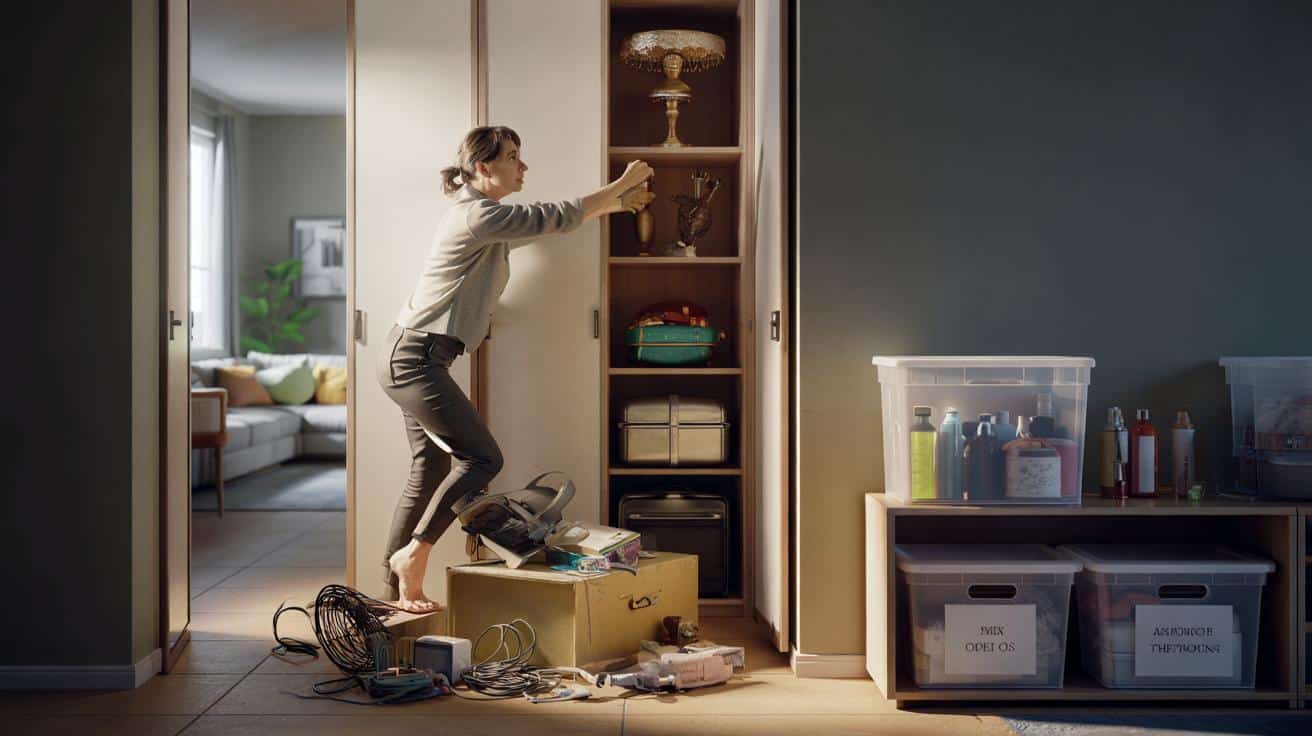
On a rainy Tuesday evening, I watched a friend climb onto a shaky chair to reach the top of her wardrobe. She was sweating, slightly annoyed, digging through a jumble of dusty boxes. Somewhere up there, hidden between an old yoga mat and a broken fan, was the cake stand she needed for her daughter’s birthday. Her living room looked tidy. Her mind did not.
She finally found it, ten minutes before guests arrived. “I only use it once a year,” she sighed. “So I put it where I don’t have to see it.”
That sentence stuck with me.
Why we exile rarely used objects to “nowhere land”
Look around your home and you’ll probably find the same pattern. The things you use daily are easy to grab. The rest? Banished to the high shelf, the back of a closet, the cellar, the random box in the garage.
We treat rarely used objects like guests we’re slightly embarrassed to host. We push them out of sight, then get angry at ourselves months later when we can’t find the very thing we carefully “stored somewhere safe”. The truth is simple: most of us don’t have a problem with space. We have a problem with logic.
Take the classic winter suitcase scene. You’re getting ready for a trip and suddenly realize your suitcase is… unknown. You open the hallway cupboard. Not there. Bedroom wardrobe? Nope. You eventually discover it behind the Christmas tree box in the basement, buried like an archaeological find.
By the time you drag it back upstairs, you’re already tired. You swear you’ll put it somewhere “more accessible” next time. Then the trip ends, you’re in a hurry, and the suitcase slides right back into that same dark corner. This tiny cycle repeats with baking dishes, camping gear, board games, power tools, seasonal decorations.
There’s a subtle cognitive trap behind all this. When we decide where to put an object, we think mostly about the moment we’re putting it away, not the moment we’ll need it again. Our brain whispers: “I won’t need this for ages, so I can throw it anywhere.”
We confuse “rarely used” with “almost useless”. That’s a big difference. A fondue set you use once a year is still incredibly useful that one evening. A passport you use twice a year is critical those two days. *The less we use something, the more strategic its place should be.*
How to give rarely used objects the “right” place
There’s a simple method professional organizers use that changes everything: decide the place based on the next use, not the last use. When you hold a rarely used object, ask yourself one concrete question: “In what mental state will I be the next time I need this?”
➡️ “This slow cooker meal is what I start in the morning when I know the day will be long”
➡️ 10 dishes you should never order in restaurants, according to professional chefs
➡️ What it means to make your bed as soon as you wake up, according to psychology
➡️ People who snack constantly often confuse boredom with hunger
If it’s “stressed, in a hurry, with guests arriving soon”, that object deserves a semi-prime spot. Not center stage like your keys, but not exile either. Think: suitcase on the lowest shelf of the wardrobe, not behind five boxes in the attic. Cake stand in a labeled kitchen box, not balanced on a wardrobe in the guest room.
Many people also mix two categories that should never touch: “rarely used but essential” and “I might use this someday”. Your spare set of house keys, legal documents, first-aid kit, and winter tires go in the first group. Old cables, random gadgets, half-broken appliances go in the second.
When these worlds collide in the same boxes or shelves, chaos arrives. You open a cupboard looking for your spare charger and end up knee-deep in mystery wires from three phones ago. You feel guilty tossing them. You close the door. The cycle continues. Let’s be honest: nobody really does this every single day.
One professional organizer I spoke to summed it up perfectly:
“The wrong place is any place you can’t describe in one clear sentence.”
Think about that while you look around. Could you calmly say, “All the things we use only for Christmas are in one labeled box on the top left shelf of the closet”? Or would your sentence sound more like, “I think… maybe… somewhere under the bed or in the garage”?
To break the pattern, create a few clearly defined “rare use” zones in your home:
- One spot for seasonal items (decorations, holiday dishes, heavy blankets)
- One spot for travel (suitcases, travel-sized toiletry bags, adapters)
- One spot for tools and DIY (drill, screws, paintbrushes, tape measure)
- One spot for “emergencies” (first-aid kit, flashlights, batteries)
Each zone gets a real shelf or box, a label, and a rule: nothing unrelated joins the party.
A home that remembers for you
There’s something oddly soothing about knowing exactly where your “once-in-a-while” objects live. It’s like your home is carrying part of your mental load. When someone invites you on a last-minute trip, you just open the same cupboard and grab the same suitcase. When your child suddenly needs that specific costume or sports bag, you’re not turning the house upside down at 8 p.m.
You start to feel a quiet confidence, a calm backbone to your daily life. Not because everything is perfect. But because fewer things are wildly out of place.
Over time, this changes your relationship with stuff. You notice that some objects don’t deserve any place at all. If something is rarely used and you also wouldn’t miss it if it disappeared, that’s a clue. It’s not “rarely used and important”. It’s just… extra.
On the other hand, certain rarely used objects gain their rightful respect. That emergency toolbox, that folder with contracts, that one formal outfit you wear once a year. They’re not annoying clutter. They’re quiet support systems. Giving them a logical, reachable place is a small form of self-respect.
You might even find yourself talking differently about your home. Not “I don’t have enough space”, but “I know exactly where my stuff lives”. That shift is subtle, almost invisible to others, yet huge on the inside. Suddenly the top of your wardrobe or the back of your closet is no longer a black hole, but a map you know by heart.
And that rainy Tuesday evening when someone needs the cake stand, or the suitcase, or the weird extension cord for the garden party, you’ll simply walk over and pick it up. No drama, no climbing dangerous chairs, no mysterious boxes to open. Just a small, satisfying click in your mind: this time, you put it in the right place.
| Key point | Detail | Value for the reader |
|---|---|---|
| Separate “rare but essential” from “maybe someday” | Give essentials defined zones, let go of low-value clutter | Less overwhelm, easier decisions when storing items |
| Decide location based on the next use | Think about your future state (tired, rushed, hosting guests) | Faster access, fewer stressful searches and last-minute panics |
| Create clear “rare use” zones | Seasonal, travel, tools, emergencies each get a dedicated spot | A home that “remembers for you”, with fewer lost objects |
FAQ:
- Where should I store things I only use once a year?
Group them by theme in clearly labeled boxes or shelves: one for holidays, one for travel, one for special occasions. The place can be high or less central, but still reachable without a ladder circus.- What about sentimental items I never use?
Give them a separate, honest category. A memory box or dedicated shelf is fine. The key is not to mix them with functional rarely used objects, so you don’t dig through nostalgia when you just need a cable.- How do I know if I should keep a rarely used item?
Ask: “Is there a real situation in the next year where I’d be relieved to have this?” If the answer feels forced or vague, the object might be clutter disguised as potential.- My home is small. Do these “zones” still work?
Yes, they can be tiny. One shelf in a wardrobe can be your entire “travel zone”. One box under the bed can be your “seasonal zone”. The clarity of the category matters more than the size.- How do I start without turning the whole house upside down?
Begin with one situation that regularly stresses you: travel, holidays, DIY fixes. Tidy and regroup only those related objects into one logical place. Once you feel the relief, the next zone will be easier.