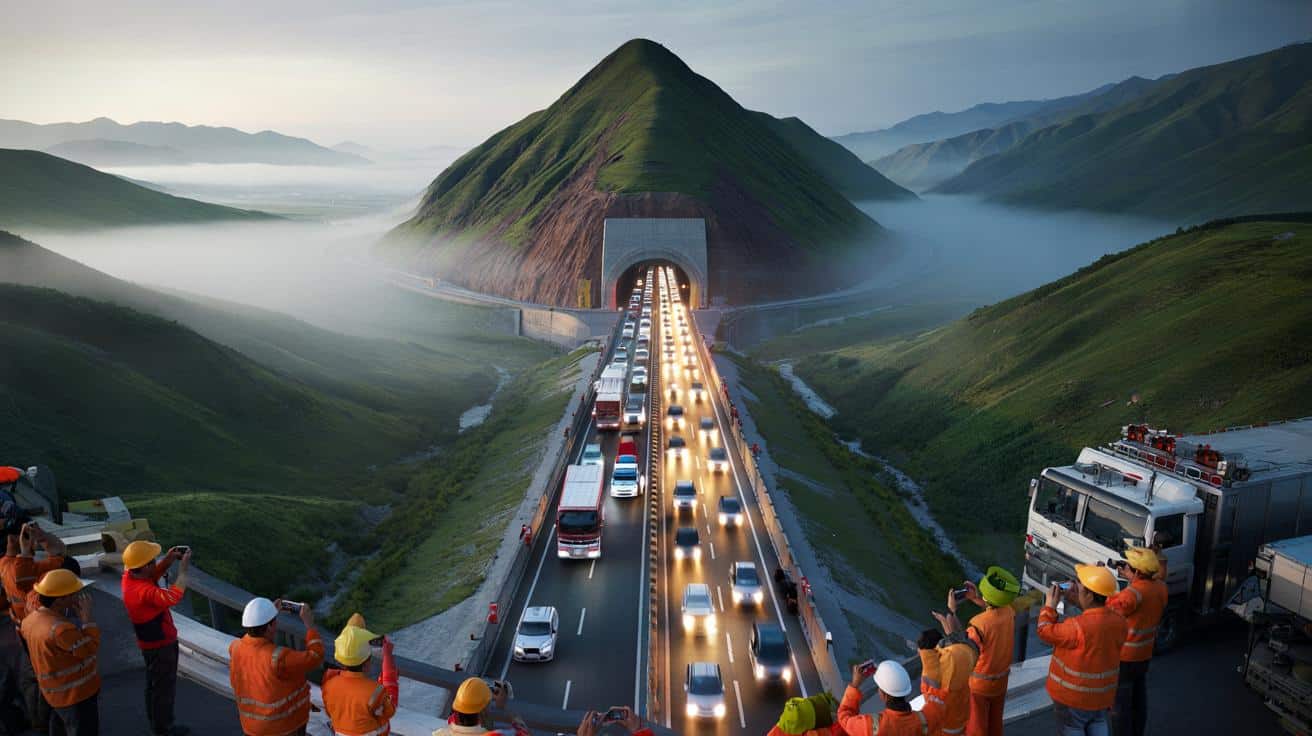
On a foggy morning in Gansu province, headlights disappear one by one into the mountainside. Trucks, buses, small family cars – they all slide into the same dark opening carved straight through the rock, as if the mountain itself has learned to breathe traffic. On the control screens in a nearby monitoring room, a yellow line slowly fills with moving dots representing every vehicle inside this new artery of concrete and steel. Outside, workers in orange vests take photos on their phones, half proud, half exhausted.
They’ve just helped finish the longest highway tunnel on the planet.
And the world is quietly watching what this means next.
China’s 22.13-kilometer tunnel that bends the rules of distance
The new highway tunnel stretches 22.13 kilometers through rugged terrain, a line of asphalt hidden deep beneath the mountains like a secret shortcut. On a map, the route between cities suddenly shrinks, as if someone casually folded the landscape. What used to be hours of winding roads, steep climbs, and risky winter driving now flows in a single, sheltered shot.
For engineers, it’s a record-breaking structure. For drivers, it’s just the fastest way to get home for dinner.
On the first official day of operation, a long-distance bus driver named Li reportedly said he almost missed the tunnel entrance, simply because he wasn’t used to the idea that such a thing could exist on his usual route. He used to brace himself for narrow curves and frequent braking, especially in snow season. Today, his journey feels almost uneventful.
Travel time drops, fuel consumption falls, and the stress of managing a heavy vehicle on mountain roads softens into a long, steady drive. A journey that once demanded full-body tension has become something closer to a routine workday.
This is exactly what mega-infrastructure projects aim to do: erase friction without fanfare. The tunnel doesn’t just break a world record on paper, it changes how a region moves, trades, and lives. Shorter logistics routes mean cheaper transport. More reliable connections mean more business, more tourism, more chances for small towns to plug into larger economies.
The 22.13-kilometer stretch might look like a feat of raw engineering, yet at ground level it mostly feels like time suddenly got a little more generous.
How you build a record-breaking tunnel without breaking everything else
Behind that smooth drive lies a method that mixes brute-force machinery with almost obsessive monitoring. Crews work from both ends of the mountain, sometimes from intermediate shafts, drilling and blasting into rock that doesn’t always behave as expected. Every meter gained is measured, scanned, checked, then checked again.
➡️ Why people feel resistance when emotional growth challenges identity
➡️ People who feel uneasy receiving support often value self-reliance
➡️ Day will turn to night with the longest total solar eclipse of the century
➡️ People who snack constantly often confuse boredom with hunger
➡️ Most people put rarely used objects in the wrong place
➡️ “This slow cooker meal is what I start in the morning when I know the day will be long”
Ventilation ducts snake through the unfinished tube, keeping fresh air flowing while giant tunnel boring machines and trucks grind and roar in the darkness.
We’ve all been there, that moment when a big project looks simple from the outside and messy from the inside. Tunnel construction is that feeling multiplied by several hundred thousand tons of rock. When groundwater suddenly appears, engineers have to build drainage systems on the fly. When the geology changes from hard granite to crumbly layers, support structures must adapt quickly.
One small miscalculation can delay weeks of work, and weeks of work can cost millions. Let’s be honest: nobody really does this every single day at this scale, so much of it is experience, data, and calculated nerve.
To keep people safe inside a 22.13-kilometer tube, you need more than nice lighting and road markings. Fireproof materials, escape galleries, cross passages, cameras, sensors that track everything from smoke to vehicle speed – it’s a dense digital nervous system.
Engineers like to say that a long tunnel is not just a road, it’s a “horizontal skyscraper” that must function, breathe, and stay secure for decades.
- Multiple emergency exits spaced along the tunnel for rapid evacuation
- Redundant ventilation systems to manage exhaust and smoke flows
- Smart traffic monitoring to detect congestion or accidents in seconds
- Dedicated firefighting points with water, foam, and communication tools
- Regular drills for staff to react fast when something goes wrong
What this record really tells us about the future of travel
At first glance, the story sounds simple: China builds the longest highway tunnel in the world and claims another line in the record books. But stay a bit longer with that image of cars disappearing into the mountainside, and another reality surfaces. This kind of project suggests that distance as we knew it is under constant negotiation.
*Mountains, deserts, and harsh winters are becoming less of a “no-go” and more of a “how soon can we get through?”*
There’s a quiet emotional shift when people realize they can leave a remote town at morning light and arrive in a major city before lunch, all on a path that didn’t exist a few years ago. Grandparents can visit grandchildren more often. Farmers can get fresh produce to larger markets before it spoils. Students can commute to universities that once felt too far away.
These stories rarely make the headlines, yet they are the real currency of mega-tunnels: less isolation, more choice, more everyday mobility.
At the same time, this new tunnel sits inside a bigger global discussion about speed, sustainability, and risk. On one side, long tunnels cut travel times and reduce fuel use by avoiding endless climbs and descents. On the other, they demand huge amounts of concrete, energy, and long-term maintenance. That tension isn’t going away.
China’s record-breaking tunnel sends a clear message: if the political will, money, and technical skill align, almost any landscape can be reshaped. The rest of the world now has to decide which barriers are worth piercing, and which might be better respected.
A new normal underground, and the questions that follow
The 22.13-kilometer tunnel feels like another step toward a world where long, dark tubes under mountains become as ordinary as flyovers and bridges. Future drivers may not even realize they’re passing through what once broke a world record; they’ll simply complain about traffic like anywhere else. That’s the strange legacy of this kind of construction: the better it works, the less extraordinary it seems.
At the same time, this project raises a quiet question for anyone watching from afar: if distances can be folded like this, which places in our own lives might be closer than we think?
| Key point | Detail | Value for the reader |
|---|---|---|
| China’s new world-record tunnel | 22.13-kilometer highway tunnel through mountainous terrain | Grasp the scale of current infrastructure and how it reshapes geography |
| Impact on daily life | Shorter travel times, safer winter driving, better logistics | See how mega-projects translate into cheaper goods and easier travel |
| Future of mobility | Growing trend of long tunnels and smart road systems | Anticipate how your own travel, work, and access to services may evolve |
FAQ:
- Question 1Where exactly is this 22.13-kilometer tunnel located in China?
- Question 2How does this tunnel compare to other long tunnels around the world?
- Question 3Is driving through such a long tunnel safe for ordinary motorists?
- Question 4What are the economic benefits of building a tunnel of this size?
- Question 5Could similar mega-tunnels be built in other countries with tough terrain?