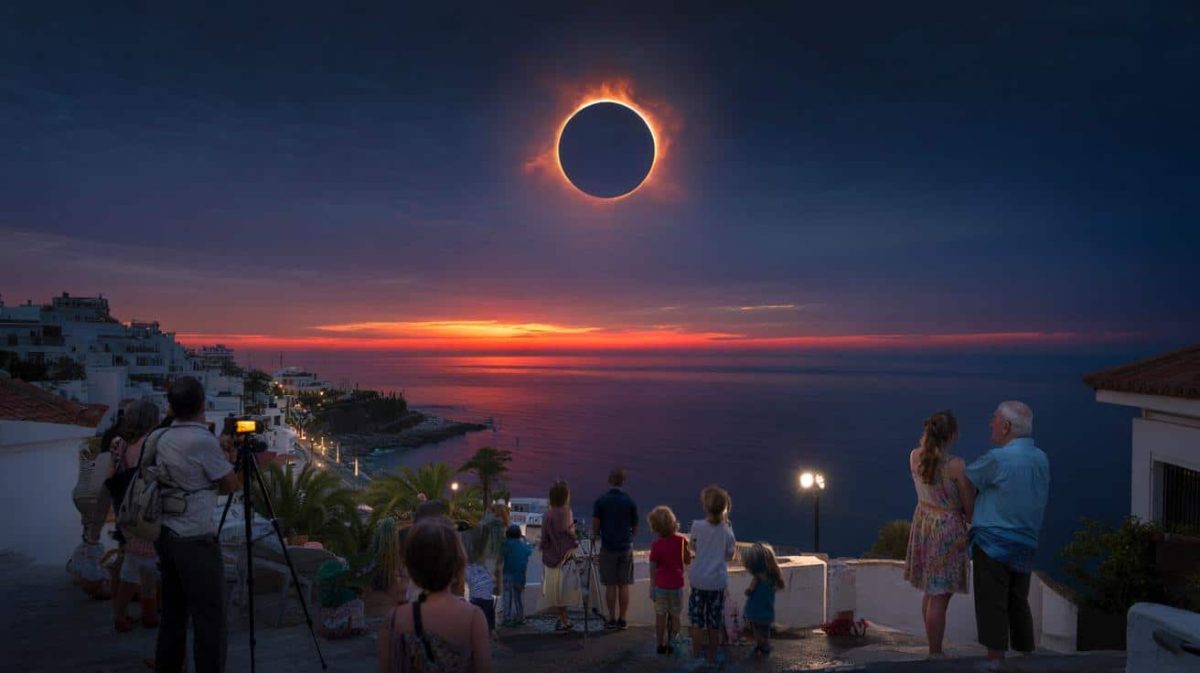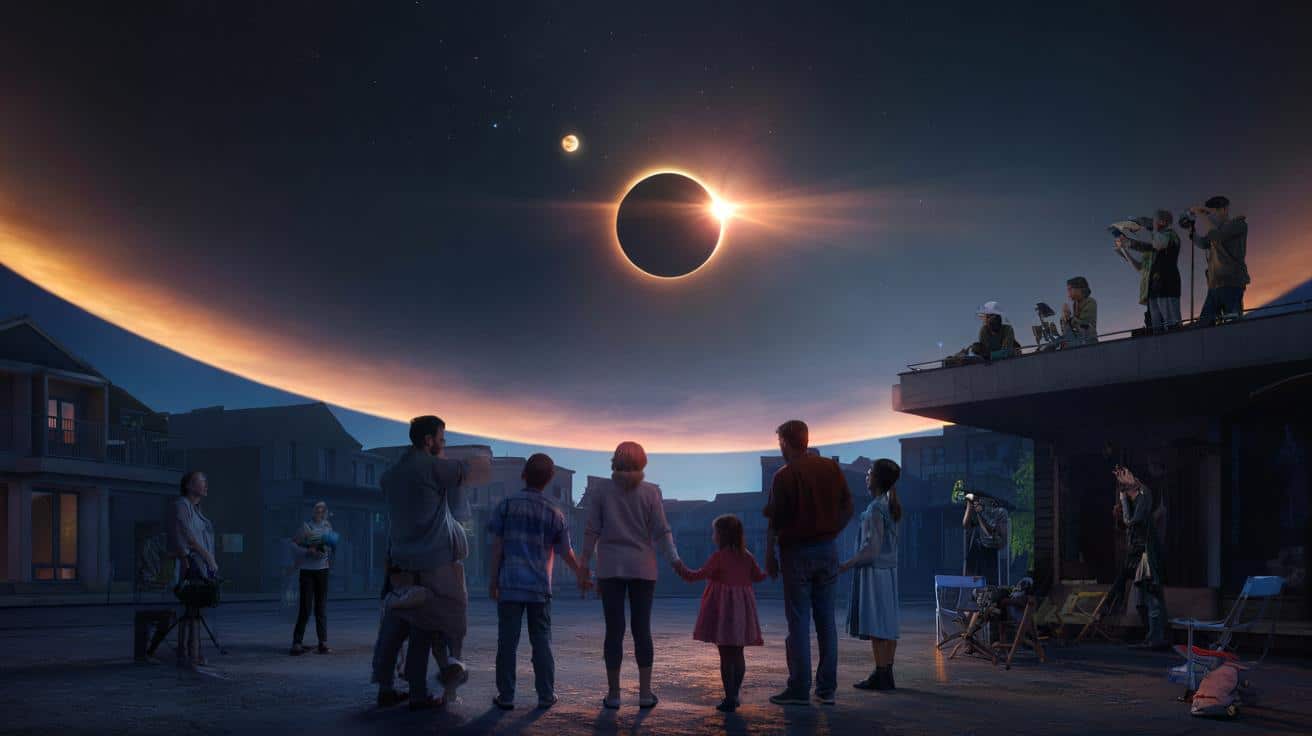
On a humid summer afternoon, the town square feels oddly restless. Parents grip their children’s hands a little tighter. Teenagers hover on balconies, phones already raised to the sky. The sun blazes like any other day, baking rooftops and drying out the last puddles from the morning rain. Yet there’s this quiet, buzzing expectation in the air, like a stadium before the lights go out.
Somewhere between the birds’ sharp calls and the low growl of traffic, people keep glancing upward. Not yet. Not quite.
Then comes the thought that pulls everyone together: in a few months, in broad daylight, the sky will simply… go dark.
When the sky suddenly forgets it’s daytime
If you’ve never seen a total solar eclipse, the descriptions always sound exaggerated. “Day turns to night,” “the stars come out,” “people cry.” It reads like marketing copy for a doomsday movie. Then you talk to someone who’s actually seen one, and their voice changes.
They don’t talk about astronomy first. They talk about the silence, the cold, that weird feeling in your chest when the light goes sideways and every color around you looks wrong.
On the path of the coming eclipse, small towns are already bracing for a sort of beautiful chaos. One rural county in Texas has quietly gone from sleepy backroad stop to projected host of tens of thousands of visitors, all chasing two key words: totality duration.
Why? Because this isn’t just another blackout of the sun. Astronomers say this will likely be the **longest total solar eclipse of the century**, with several locations expecting more than six minutes of eerie midday night. For comparison, plenty of recent eclipses barely gave people two minutes. Six minutes is long enough to gasp, look around, adjust, and still feel your brain quietly whisper: “This can’t be real.”
There’s a simple reason this one stretches out like slow motion. The Moon’s orbit is slightly elliptical, so sometimes it’s closer to Earth, sometimes farther. During this event, the Moon will be near perigee — a bit closer to us — so it appears larger in the sky. At the same time, the Earth will be positioned so the Moon’s shadow lingers over a narrow path, sweeping slowly across continents.
All those orbital coincidences add up. The result: a shadow that doesn’t just blink across the landscape, but settles in, giving millions of people a rare extended window into *utter, impossible daylight darkness*.
How to experience six minutes of moving darkness
First thing: you need to be under the path of totality. Not near it, not “close enough.” Within or you miss the show. Astronomers publish detailed maps, and local governments are already sharing them like festival lineups.
➡️ What it means to make your bed as soon as you wake up, according to psychology
➡️ People who feel uneasy receiving support often value self-reliance
➡️ Why people feel resistance when emotional growth challenges identity
➡️ People who snack constantly often confuse boredom with hunger
➡️ Most people put rarely used objects in the wrong place
If you live just outside that thin band, start planning a short trip. Book a hotel, a spare room, even a campsite along the line. Then build your day around a single moment: when the Moon fully gobbles up the Sun and the world slides into that deep, metallic twilight.
Most people, understandably, get nervous about their eyes. They buy last‑minute glasses from sketchy websites, or they forget entirely and end up squinting through a cereal box pinhole that doesn’t really work. Let’s be honest: nobody really reads those official viewing guides line by line.
Yet this is one of those times where tiny bits of preparation pay off hugely. Real eclipse glasses carry an ISO 12312‑2 certification number and feel surprisingly dark — you shouldn’t see anything except the Sun through them. You’ll wear them right up until the moment of totality, then briefly take them off when the Sun is fully covered. Put them back on as soon as even a sliver of sunlight returns. Your future self will thank you.
During a 2017 eclipse in the U.S., veteran eclipse-chaser and astronomer Dr. Carla Ruiz told me, “People think they’re coming to see the Sun disappear. What shakes them is watching everyone around them fall silent at the same time. It’s like the whole landscape takes a breath in and forgets to exhale.”
- Check the exact time of totality for your location and set an alarm on your phone.
- Test your eclipse glasses a few days before, not five minutes before first contact.
- Have two viewing spots in mind in case clouds roll in at the last moment.
- Decide in advance: are you watching with your eyes, or through your camera?
- Leave early. Traffic on eclipse day has a way of going from normal to surreal.
The quiet shock of watching your own daylight disappear
What lingers in people’s stories isn’t just the astronomy. It’s the feeling of watching a familiar world tilt. Chickens head to their coops in the middle of the afternoon. Streetlights flicker on in confused cities. The temperature drops, and a breeze flows in from nowhere, as if the planet is exhaling through a hidden vent.
We’ve all been there, that moment when ordinary life suddenly looks strange — a power cut, an unexpected snowfall, a city street emptied by some unseen event. An eclipse is like that, but scripted by the sky itself.
| Key point | Detail | Value for the reader |
|---|---|---|
| Path of totality matters | You must stand under the narrow Moon shadow to see full darkness | Avoid disappointment from only seeing a partial eclipse |
| Duration is historic | This event may offer over six minutes of totality in prime locations | Rare chance to really settle into the experience, not just blink and miss it |
| Preparation is simple | Certified glasses, timing, and a good viewing spot are the essentials | Low-cost planning, high emotional payoff |
FAQ:
- Question 1Will day really turn into full night during the eclipse?In the path of totality, it will feel like a deep, strange twilight — stars and planets may appear, and the horizon can glow as if sunset is happening in every direction.
- Question 2Is it safe to look at the eclipse with the naked eye at any point?Only during totality, when the Sun is completely covered, is it safe to look without protection. Before and after, you need proper eclipse glasses or an indirect viewing method.
- Question 3Do I need a telescope or special camera to enjoy it?No. The human eye is enough. Many eclipse chasers skip photography entirely during totality to soak in the moment.
- Question 4What if it’s cloudy where I am?Cloud cover can block the Sun, but you’ll still experience the sudden darkness, the temperature drop, and the eerie shift in atmosphere. Some people even chase breaks in the clouds by car.
- Question 5Will there be another eclipse like this soon?There will be other eclipses, but a **total** eclipse with such a long duration over populated areas is rare. That’s why so many people are already calling this one the eclipse of the century.